Basic Knowledge for Illustrators 03: Understanding the Workflow from Receiving a Commission to Delivering the Final Work
- MORI Ryuichiro

- May 13
- 9 min read
Updated: May 24
(I am writing based on the circumstances of the Japanese illustrator industry. )
■ Receiving Inquiries for Illustration Work
In today’s illustration industry, most work inquiries arrive by email.
For that reason, make sure to check your email every day.
Even if you rarely receive work inquiries, once you have presented yourself as a professional, you should check your email daily.
I believe this is one of the most basic responsibilities of a professional.
Ideally, you should also set things up so that you can receive emails sent to the same address on your smartphone.
This greatly reduces the chance that you will miss an email.
If you use separate email addresses for work and private messages, it becomes easier to distinguish business emails from personal ones.
It is not uncommon for work inquiry emails to be sorted into the spam folder, so be sure to check your spam folder every day as well.
If you write something like “For commissions, please contact me by DM” on social media, inquiries may come through direct messages.
If you have already worked with a client several times and are connected through LINE, Chatwork, Slack, or similar tools, they may contact you there instead.
In very rare cases, it seems that work inquiries are still made by phone.
■ Checking the Terms and Conditions
When you receive an inquiry, the first thing to do is confirm the terms and conditions.
You must not say, “I accept the job,” before checking the terms.
Once you have said you will accept the job, it becomes difficult to decline if unfavorable conditions are imposed afterward.
At this stage, you should confirm the following 14 items.
① The name, company name, address, telephone number, and email address of the person placing the order.
② If the ultimate client is different from the person contacting you, the name of that client.This is important because the fee can vary greatly depending on the size and nature of the ultimate client.
③ The medium in which the illustration will be used.For example: magazine illustration, book cover, poster, packaging, web, and so on.
④ The approximate content of the illustration.For example: a spot illustration for a fortune-telling article in 〇〇 Magazine, the cover illustration for novelist 〇〇’s new book, or a Christmas campaign poster for shopping center 〇〇.
⑤ The deadline.
⑥ The planned publication date or period of use.
⑦ The number of illustrations and their sizes.
⑧ The fee.When I was just starting out, it was rare for clients to tell me the fee in advance. Today, however, they usually do. Under Japan’s Subcontract Act, clients are also required to present the fee in advance. Always confirm the fee beforehand and proceed with the work only after both parties have agreed.
⑨ Whether there will be secondary use, or reuse.Because the fee changes depending on whether secondary use is involved, confirm this at the very beginning.
⑩ The territory of use.Because the fee changes depending on where the work will be used, confirm this at the very beginning. Use limited to a local area is cheaper than nationwide use. If the work will also be used overseas, the fee should be even higher.
⑪ Whether work for competing companies will be prohibited.If there is a non-compete restriction, the fee should be higher.
⑫ Whether the contract involves a transfer of copyright.If copyright transfer is a condition, negotiation may be necessary.
⑬ Whether the illustrator can exercise moral rights.If you are not allowed to exercise your moral rights as the author, negotiation may be necessary.
⑭ Whether you are allowed to publicly show the work as part of your portfolio.If you are not allowed to disclose the work as a professional achievement, you should ask for a higher fee.
■ When You Are Asked for an Estimate
If the fee has not been decided, you may be asked to provide an estimate.
However, do not agree too casually.
When you are asked for an estimate, the basic rule is to ask about the budget instead.
I will explain that again in another lecture someday.
■ Deciding Whether to Accept the Job
Once you have been told the terms, conditions, and fee, you should consider whether or not to accept the job.
When you are just starting out, it may be acceptable to take on lower-paying work in order to build your track record.
I will explain that again in another lecture someday.
Another important point is whether your schedule is available.
For a large advertising job, the deadline may be several months away.
For magazine spot illustrations, however, it is not unusual to have only about one week before the deadline.
In that one week, you may have to draw more than ten illustrations.
There are also cases where another illustrator has run into trouble and the client says, “We urgently need a substitute. Could you somehow finish it by tomorrow?”
In my case, I gladly accepted such requests.
I believe that because I completed those jobs properly, I gained trust, and my work continued to increase.
■ Meetings
When I was just starting out, even small jobs usually involved meeting in person.
Today, however, most jobs are handled only through email and similar forms of communication.
Since the COVID-19 pandemic, more meetings have also been handled online through tools such as Zoom.
Even so, there are still cases where you will meet in person.
This is more likely when the client is older, when the client is particularly thorough, or when the job is large.
If it is your first inquiry from an unfamiliar company, I recommend visiting the client’s workplace for the meeting.
It is good to see for yourself what kind of company they are.
However, in-person meetings leave no written record.
Mishearing and misunderstanding can easily occur.
For that reason, by the next day, send an email summarizing the important points and asking the client to confirm them.
For example:
I have summarized the content of yesterday’s meeting.To avoid any mishearing or misunderstanding on my part, could you please confirm the details?
If the meeting is far away, transportation and accommodation costs may be involved.
For example, an illustrator living in Tokyo may be asked to attend a meeting in New York.
In such cases, it is best to ask for an online meeting if possible.
If the client still requests an in-person meeting, it is acceptable to ask whether they can cover your transportation and accommodation expenses.
Generally speaking, meal expenses are not covered.
■ Finding Reference Materials
In many cases, you will need to find reference materials before drawing.
This is because illustrators sometimes have to draw things they have never seen or even heard of.
If you ask the editor, they may send you reference materials.
In my case, I often took reference photographs myself.
I once even went to Nikko Edomura to photograph reference materials for a historical illustration.
Today, if you search online, you can find almost anything, can’t you?
But if you simply draw from those images as they are, it may constitute copyright infringement.
As much as possible, I recommend taking your own reference photographs.
Make it a habit to photograph things in your daily life that might become useful reference materials.


■ Creating Rough Sketches
Once you have found your reference materials, begin creating rough sketches.
Illustrators create rough sketches for most jobs.
This is because there is often a gap between the client’s intention and the illustrator’s understanding.
○ Number of Rough Sketches
There is no fixed rule for how many rough sketches you should submit.
In general, one to three rough sketches is probably typical.
For low-budget jobs or jobs where you are simply drawing almost exactly as instructed, one rough sketch is probably enough.
If you are drawing several dozen illustrations at once, one rough sketch per illustration is also probably enough in most cases.
For illustrations that receive large treatment, such as a full magazine page or a two-page spread, it is better to submit about two or three rough sketches.
For a book cover, I think it is better to submit about three rough sketches.
If you have the capacity, you may submit five or six.
In my case, book covers were often left up to me.
Even in those cases, I usually submitted about three rough sketches.
Even when I was expected to draw according to instructions, I often submitted three types:
・A rough sketch that followed the instructions exactly
・A rough sketch that added a small idea to the instructions
・A rough sketch that differed from the instructions but was based on my own idea
For literary magazine illustrations and weekly magazine illustrations, I used to submit about two rough sketches.
Gradually, this became one rough sketch, and when there was no time, I would finish the illustration without submitting a rough sketch.
This was only because I had become able to intuitively understand what the client wanted.
Those of you who are just starting out should submit rough sketches.
○ How Detailed Should a Rough Sketch Be?
I am sometimes asked, “How detailed should a rough sketch be?”
There is no fixed rule.
Make it detailed enough for the client to easily imagine the finished work.
In my case, for black-and-white illustrations, I submitted pencil line drawings as rough sketches.

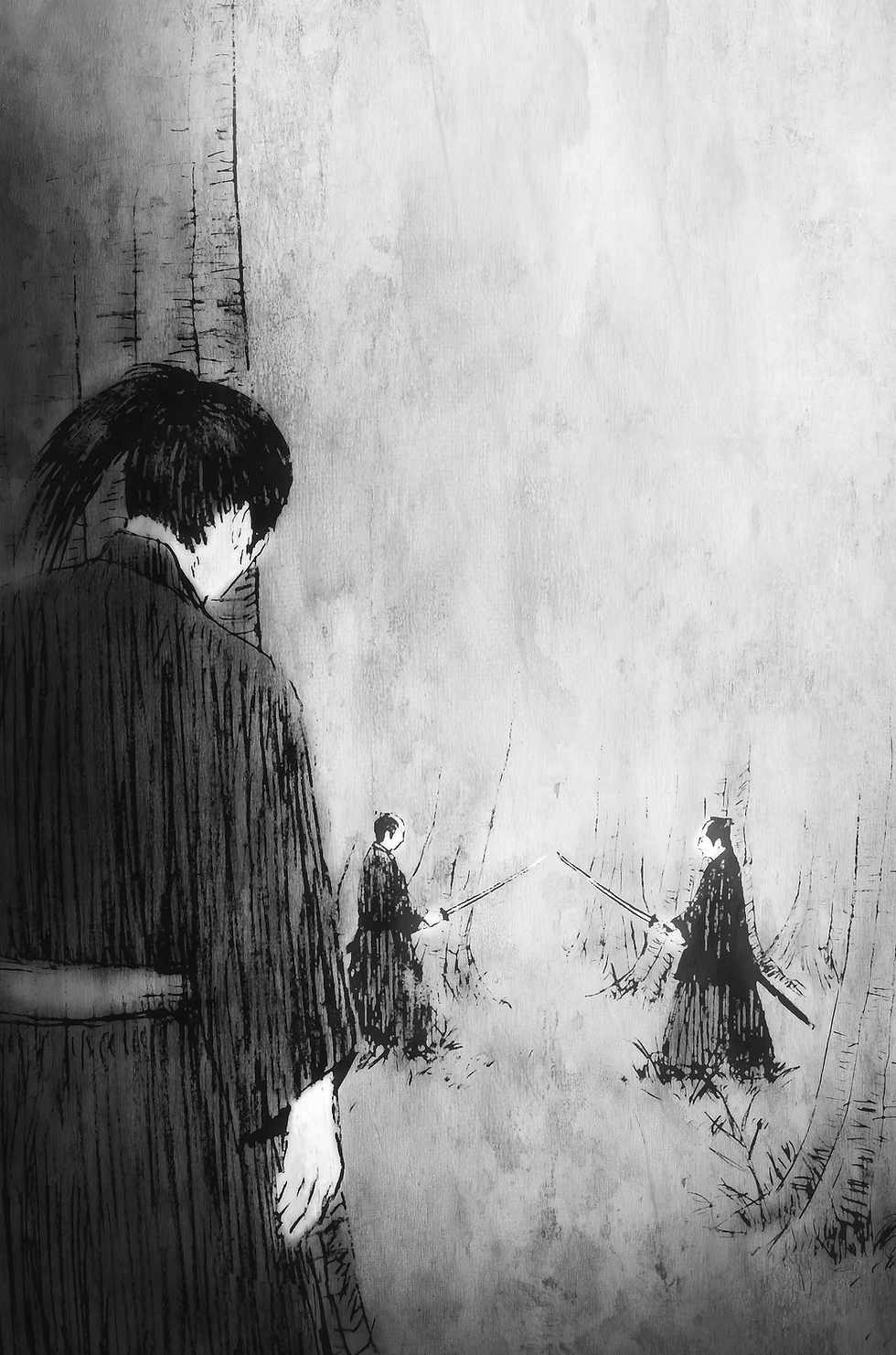
When I was just starting out, I also submitted line drawings for book cover rough sketches.
At that time, rough sketches were sent by fax, so it was impossible to send them in color.
However, with the spread of computers and the internet, it became possible to send color roughs.
Gradually, I came to send color roughs that were almost finished pieces.
Sometimes I also include variations with different colors or different cropping.
Not only in my case, but among illustrators who work digitally, it seems increasingly common to submit color roughs that are almost indistinguishable from the final artwork.
There are also many analog illustrators who create their rough sketches digitally.
In other words, they quickly add color digitally for the rough sketch, then create the final artwork with paint.
■ Checking Rough Sketches
Once the rough sketches are complete, attach them to an email and send them to the client for confirmation.
If you use your email software with its default settings, the attached images may become low-resolution.
Make sure your settings allow you to send images at their original size.
Alternatively, compressing the files before sending them can also prevent image degradation.
■ Revising Rough Sketches
Sometimes a rough sketch is approved on the first try, but it is also quite common to be asked for revisions.
When you are asked to revise something, respond sincerely.
Especially when you are just starting out, you may be asked to revise your work many, many times.
There were times when I also had to redraw something repeatedly before it was finally approved.
Looking back, I think this was because my skills were not yet sufficient.
I believe this is a test of your ability to respond flexibly to the client’s requests.
Some people seem to become discouraged at this stage and quit being illustrators.
A request for revision is not a rejection of you as a person.
Understanding that, respecting the client’s intention, and aiming for the best possible result is what makes someone a professional illustrator.
■ Finishing the Illustration
Once the rough sketch has been approved, move on to the final artwork.
■ Delivery
When the illustration is complete, deliver it to the client.
If you are delivering digital data:
prepare the file in PSD or AI format,
place everything in one folder,
compress the folder,
and send it using a large-file transfer service such as Dropbox Transfer.
If you are sending original analog artwork, protect the work with tracing paper or similar materials and send it by courier.
■ Sending an Invoice
Some clients require an invoice, while others do not.
If an invoice is required, send it after delivery.
Today, you do not need to send invoices on paper.
Attach a PDF file to an email and send it electronically.
■ Checking Color Proofs and Samples
Depending on the job, the client may send you color proofs or product samples.
■ Receiving Finished Samples
When the book or product is completed, finished samples usually arrive around the release date.
If they do not arrive after some time, contact the client.
Sometimes the person in charge simply forgets.
■ Sending a Thank-You Note
When you receive finished samples, send a thank-you note.
Email is acceptable, but a postcard is better.
A handwritten thank-you note increases the possibility of receiving future work.
■ Confirming Payment
One thing that is easy to forget is confirming payment.
Once a month, either at the end of the month or the beginning of the month, you should check whether payments have been made.
If there is any unpaid fee, send an inquiry to the client.
In most cases, the person in charge has simply forgotten.
However, in very rare cases, the company may be on the verge of going out of business and may be having difficulty making payments.
It is best to check early and make inquiries promptly.
Once you have confirmed that the payment has been made, the job is complete.
------------------------------------------------------------
If you liked this article, please click the heart mark below.


Comments